Buy toolchain.eu ?
We are moving the project
toolchain.eu .
Are you interested in purchasing the domain
toolchain.eu ?
domain@kv-gmbh.de · 0541-91531010
Buy toolchain.eu ?
What is the conductor resistance in electrical engineering?
Conductor resistance in electrical engineering refers to the opposition that a conductor offers to the flow of electric current. It is caused by the collisions of free electrons with atoms in the conductor material, leading to the conversion of electrical energy into heat. The resistance of a conductor is dependent on its material, length, cross-sectional area, and temperature. It is measured in ohms (Ω) and plays a crucial role in determining the efficiency and performance of electrical circuits. **
How do you calculate resistance in electrical engineering?
Resistance in electrical engineering is calculated using Ohm's Law, which states that resistance (R) is equal to the voltage (V) across a component divided by the current (I) flowing through it. Mathematically, this can be represented as R = V/I. By measuring the voltage and current in a circuit, you can use this formula to determine the resistance of a component. Additionally, resistance can also be calculated using the formula R = ρ * (L/A), where ρ is the resistivity of the material, L is the length of the component, and A is the cross-sectional area. **

Similar search terms for Kérastase-Resistance-Ciment-Thermique
Top-Angebote
Products related to Kérastase-Resistance-Ciment-Thermique:
-
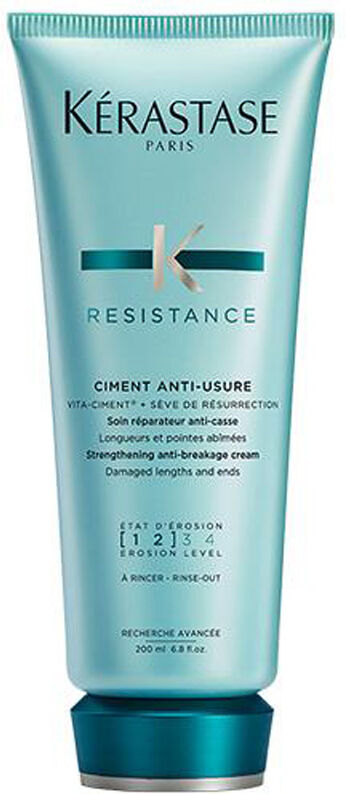
Kérastase Resistance Ciment Anti-Usure 200mlKérastase Ciment Anti-Usure is a repairing, anti-breakage conditioner specifically for weakened, damaged hair that is prone to splitting and breaking. Key Ingredients: Pro-Keratin - A strengthening protein to mimic natural keratin for stronger, healthier hair Ceramide - To strengthen hair fibre from the inside out Developed with Vita-Ciment®, the strengthening conditioner reinforces each hair fibre from the inside out for healthier, smooth result that's full of shine! Erosion Levels: 1-2 Ingredients: AQUA / WATER / EAU • BEHENTRIMONIUM CHLORIDE • CETEARYL ALCOHOL • PEG-180 • CETYL ESTERS • ISONONYL ISONONANOATE • ELAEIS GUINEENSIS OIL / PALM OIL • ISOPROPYL ALCOHOL • PHENOXYETHANOL • HYDROXYETHYLCELLULOSE • 2-OLEAMIDO-1,3-OCTADECANEDIOL • CHLORHEXIDINE DIGLUCONATE • AMYL CINNAMAL • HEXYL CINNAMAL • BENZYL ALCOHOL • LINALOOL • HYDROXYCITRONELLAL • CITRONELLOL • GLYCERIN • CITRIC ACID • TREHALOSE • TAMARINDUS INDICA SEED POLYSACCHARIDE • CI 19140 / YELLOW 5 • CI 42090 / BLUE 1 • MYROTHAMNUS FLABELLIFOLIA LEAF EXTRACT • DISODIUM PHOSPHATE • PARFUM / FRAGRANCE28,00 £*Shipping: 0,00 £Secure redirect to the provider
-
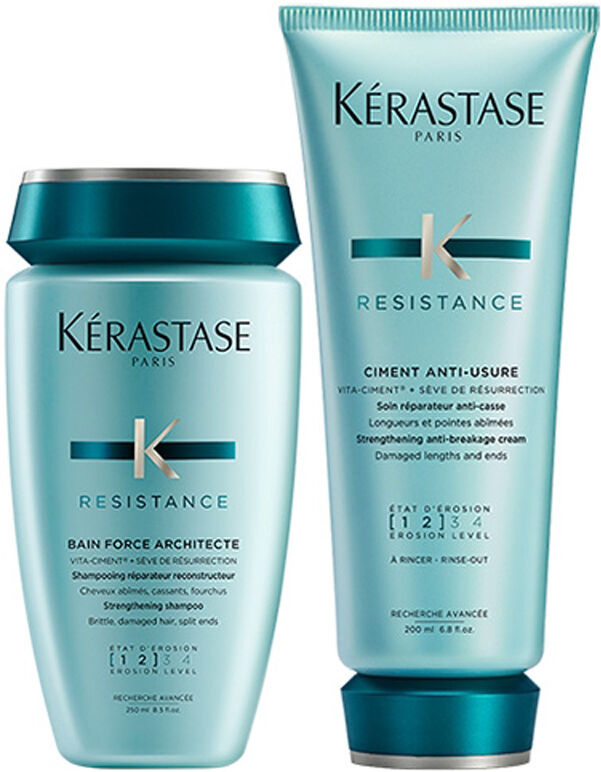
Kérastase Resistance Bain Force Architecte 250ml & Ciment Anti-UsureKérastase Bain Force Architecte is the replacement for Bain De Force.Kérastase Bain Force Architecte 250ml & Ciment Anti-Usure 200ml Duo strengthens and repairs weakened, damaged hair that is prone to split ends. Includes: Kérastase Bain Force Architecte 250ml Kérastase Ciment Anti-Usure 200ml Developed with Vita-Ciment®, the strengthening shampoo and conditioner reinforces each hair fibre from the inside out for healthier, smooth result that's full of shine!46,88 £*Shipping: 0,00 £Secure redirect to the provider
-
Kérastase Resistance Bain Force Architecte Ciment Anti-Usure & CimenKérastase Bain Force Architecte, Ciment Anti-Usure & Ciment Thermique Pack is your 3-step regime to restore strength and vitality to weakened, damaged hair that is prone to split ends. Includes: Kérastase Bain Force Architecte 250ml Kérastase Ciment Anti-Usure 200ml Kérastase Resistance Ciment Thermique Glacage Thermo-Seal 150ml Developed with Vita-Ciment, the Resistance range reinforces and repairs each hair fibre from the inside out.74,63 £*Shipping: 0,00 £Secure redirect to the provider
-
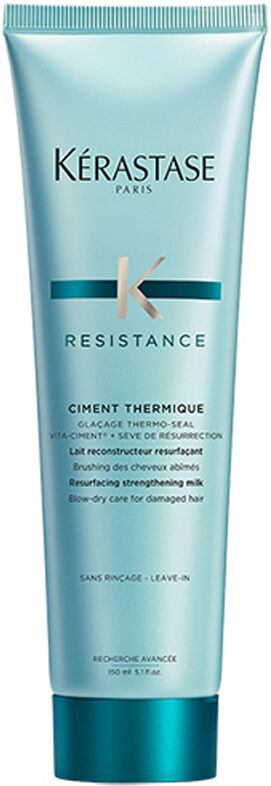
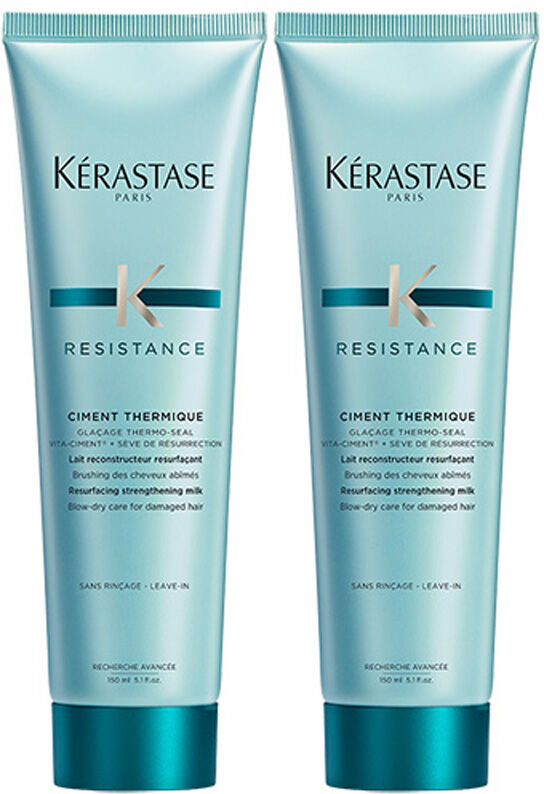
Kérastase Resistance Ciment Thermique Glacage Thermo-Seal 150ml DoublKérastase Resistance Ciment Thermique is a strengthening and resurfacing blow-dry milk designed for weak, brittle hair prone to breaking. The reinforcing treatment milk protects damaged hair from thermal styling (Up to 180°C), helps to reduce blow dry time and instantly smoothes the hair fibre, strengthening it from within.Key Ingredients: Glaçage Thermo-Seal – To smooth, add shine and maintain manageability Glucose Polymer - A Resurfacing active ingredient that creates a protective coating around the hair fibre, avoiding cracks and split ends Vita-Ciment® - Designed to recreate the intercellular structure of hair fibre for a strengthened, reinforced result55,50 £*Shipping: 0,00 £Secure redirect to the provider

-
How can the resistance R3 be determined in electrical engineering?
The resistance R3 in an electrical circuit can be determined using Ohm's law, which states that resistance (R) is equal to voltage (V) divided by current (I), or R = V/I. To determine R3, one would need to measure the voltage across R3 and the current flowing through it. Once these values are known, the resistance R3 can be calculated using Ohm's law. Alternatively, R3 can also be determined by using a multimeter to directly measure the resistance. **
-
What is the difference between resistance and specific resistance?
Resistance is the opposition to the flow of electric current in a material, measured in ohms. It is a property of the material itself. Specific resistance, also known as resistivity, is a material property that quantifies how strongly a material opposes the flow of electric current. It is a characteristic of the material's composition and is used to calculate the resistance of a specific shape and size of material. **
-
What is the difference between electrical resistance and specific resistance?
Electrical resistance is the opposition to the flow of electric current in a material, measured in ohms. It is a property of the material itself and is dependent on factors such as the material's dimensions and temperature. Specific resistance, on the other hand, is a material property that quantifies how much a material resists the flow of electric current compared to a standard material. It is also known as resistivity and is measured in ohm-meters. In essence, electrical resistance is the overall resistance of a material, while specific resistance is a more intrinsic property of the material itself. **
-
What are the tolerances for resistance chains and resistance cubes?
The tolerances for resistance chains and resistance cubes typically vary depending on the manufacturer and the specific product. However, in general, resistance chains and cubes are designed to have tight tolerances to ensure accurate and consistent resistance levels for users. It is common for resistance chains and cubes to have tolerances within a few percentage points to maintain their effectiveness and reliability during workouts. It is recommended to refer to the product specifications provided by the manufacturer for more detailed information on the tolerances of specific resistance chains and cubes. **


How do I calculate the resistance with the internal resistance?
To calculate the total resistance with the internal resistance, you can use the formula: R_total = R_internal + R_external, where R_total is the total resistance, R_internal is the internal resistance, and R_external is the external resistance. This formula takes into account the resistance from both the internal and external components of the circuit. By adding the internal and external resistances together, you can determine the total resistance in the circuit. **
What is the difference between insulation resistance and surface resistance?
Insulation resistance measures the resistance to the flow of current through the insulation material between two conductors, while surface resistance measures the resistance to the flow of current across the surface of a material. Insulation resistance is typically used to assess the effectiveness of insulation materials in preventing current leakage, while surface resistance is used to evaluate the cleanliness and conductivity of surfaces in electronic and electrical applications. In summary, insulation resistance measures the resistance through a material, while surface resistance measures the resistance across a material's surface. **
Top-Angebote
Products related to Kérastase-Resistance-Ciment-Thermique:
-
Kérastase Resistance Ciment Thermique 125mlKérastase Resistance Ciment Thermique is a strengthening and resurfacing blow-dry milk designed for weak, brittle hair prone to breaking. The reinforcing treatment milk protects damaged hair from thermal styling (Up to 180°C), helps to reduce blow dry time and instantly smoothes the hair fibre, strengthening it from within.Key Ingredients: Glaçage Thermo-Seal – To smooth, add shine and maintain manageability Glucose Polymer - A Resurfacing active ingredient that creates a protective coating around the hair fibre, avoiding cracks and split ends Vita-Ciment® - Designed to recreate the intercellular structure of hair fibre for a strengthened, reinforced result29,60 £*Shipping: 0,00 £Secure redirect to the provider
-
Kérastase Kerastase Resistance Ciment Thermique Glacage Thermo-Seal 150ml DoubleSay hello to this best-selling heat protection milk from Kerastase, the Resistance range. What does it do? Strengthens, rebuilds and repairs the hair strand to give your hair the health boost it needs to look gorgeous! Heat protection that prevents the breakage and appearing of split ends. Contains Kerastase's trademark formula Vita-Ciment® Topseal, working to strengthen and rebuild hair from the inside out whilst also repairing the outer layer leaving a protective topcoat. Ingredients: Aqua • Water • Cyclopentasiloxane • Propylene Glycol • Dimethiconol • Triethanolamine • Phenoxyethanol • Peg • Ppg-17 • 18 Dimethicone • Carbomer • Behentrimonium Chloride • Polyquaternium-4 • Potato Starch Modified • Hydroxypropyl Guar • Methylparaben • Limonene • Amodimethicone • Cetyl Alcohol • Quaternium-87 • Behentrimonium Methosulfate • Quaternium-33 • Trideceth-6 • 2-Oleamido-1 • 3-Octadecanediol • Geraniol • Linalool • Glycerin • Citronellol • Citral • Cetrimonium Chloride • Trehalose • Tamarindus Indica Seed Polysaccharide • Myrothamnus Flabellifolia Leaf Extract • Parfum • Fragrance.55,50 £*Shipping: 0,00 £Secure redirect to the provider
-
Kérastase Resistance Ciment Anti-Usure 200mlKérastase Ciment Anti-Usure is a repairing, anti-breakage conditioner specifically for weakened, damaged hair that is prone to splitting and breaking. Key Ingredients: Pro-Keratin - A strengthening protein to mimic natural keratin for stronger, healthier hair Ceramide - To strengthen hair fibre from the inside out Developed with Vita-Ciment®, the strengthening conditioner reinforces each hair fibre from the inside out for healthier, smooth result that's full of shine! Erosion Levels: 1-2 Ingredients: AQUA / WATER / EAU • BEHENTRIMONIUM CHLORIDE • CETEARYL ALCOHOL • PEG-180 • CETYL ESTERS • ISONONYL ISONONANOATE • ELAEIS GUINEENSIS OIL / PALM OIL • ISOPROPYL ALCOHOL • PHENOXYETHANOL • HYDROXYETHYLCELLULOSE • 2-OLEAMIDO-1,3-OCTADECANEDIOL • CHLORHEXIDINE DIGLUCONATE • AMYL CINNAMAL • HEXYL CINNAMAL • BENZYL ALCOHOL • LINALOOL • HYDROXYCITRONELLAL • CITRONELLOL • GLYCERIN • CITRIC ACID • TREHALOSE • TAMARINDUS INDICA SEED POLYSACCHARIDE • CI 19140 / YELLOW 5 • CI 42090 / BLUE 1 • MYROTHAMNUS FLABELLIFOLIA LEAF EXTRACT • DISODIUM PHOSPHATE • PARFUM / FRAGRANCE28,00 £*Shipping: 0,00 £Secure redirect to the provider
-
Kérastase Resistance Bain Force Architecte 250ml & Ciment Anti-UsureKérastase Bain Force Architecte is the replacement for Bain De Force.Kérastase Bain Force Architecte 250ml & Ciment Anti-Usure 200ml Duo strengthens and repairs weakened, damaged hair that is prone to split ends. Includes: Kérastase Bain Force Architecte 250ml Kérastase Ciment Anti-Usure 200ml Developed with Vita-Ciment®, the strengthening shampoo and conditioner reinforces each hair fibre from the inside out for healthier, smooth result that's full of shine!46,88 £*Shipping: 0,00 £Secure redirect to the provider
-
What is the conductor resistance in electrical engineering?
Conductor resistance in electrical engineering refers to the opposition that a conductor offers to the flow of electric current. It is caused by the collisions of free electrons with atoms in the conductor material, leading to the conversion of electrical energy into heat. The resistance of a conductor is dependent on its material, length, cross-sectional area, and temperature. It is measured in ohms (Ω) and plays a crucial role in determining the efficiency and performance of electrical circuits. **
-
How do you calculate resistance in electrical engineering?
Resistance in electrical engineering is calculated using Ohm's Law, which states that resistance (R) is equal to the voltage (V) across a component divided by the current (I) flowing through it. Mathematically, this can be represented as R = V/I. By measuring the voltage and current in a circuit, you can use this formula to determine the resistance of a component. Additionally, resistance can also be calculated using the formula R = ρ * (L/A), where ρ is the resistivity of the material, L is the length of the component, and A is the cross-sectional area. **
-
How can the resistance R3 be determined in electrical engineering?
The resistance R3 in an electrical circuit can be determined using Ohm's law, which states that resistance (R) is equal to voltage (V) divided by current (I), or R = V/I. To determine R3, one would need to measure the voltage across R3 and the current flowing through it. Once these values are known, the resistance R3 can be calculated using Ohm's law. Alternatively, R3 can also be determined by using a multimeter to directly measure the resistance. **
-
What is the difference between resistance and specific resistance?
Resistance is the opposition to the flow of electric current in a material, measured in ohms. It is a property of the material itself. Specific resistance, also known as resistivity, is a material property that quantifies how strongly a material opposes the flow of electric current. It is a characteristic of the material's composition and is used to calculate the resistance of a specific shape and size of material. **
Similar search terms for Kérastase-Resistance-Ciment-Thermique
-
Kérastase Resistance Bain Force Architecte Ciment Anti-Usure & CimenKérastase Bain Force Architecte, Ciment Anti-Usure & Ciment Thermique Pack is your 3-step regime to restore strength and vitality to weakened, damaged hair that is prone to split ends. Includes: Kérastase Bain Force Architecte 250ml Kérastase Ciment Anti-Usure 200ml Kérastase Resistance Ciment Thermique Glacage Thermo-Seal 150ml Developed with Vita-Ciment, the Resistance range reinforces and repairs each hair fibre from the inside out.74,63 £*Shipping: 0,00 £Secure redirect to the provider
-
Kérastase Resistance Ciment Thermique Glacage Thermo-Seal 150ml DoublKérastase Resistance Ciment Thermique is a strengthening and resurfacing blow-dry milk designed for weak, brittle hair prone to breaking. The reinforcing treatment milk protects damaged hair from thermal styling (Up to 180°C), helps to reduce blow dry time and instantly smoothes the hair fibre, strengthening it from within.Key Ingredients: Glaçage Thermo-Seal – To smooth, add shine and maintain manageability Glucose Polymer - A Resurfacing active ingredient that creates a protective coating around the hair fibre, avoiding cracks and split ends Vita-Ciment® - Designed to recreate the intercellular structure of hair fibre for a strengthened, reinforced result55,50 £*Shipping: 0,00 £Secure redirect to the provider
-
Kérastase Resistance Ciment Thermique Glacage Thermo-Seal 150ml DoublKérastase Resistance Ciment Thermique is a strengthening and resurfacing blow-dry milk designed for weak, brittle hair prone to breaking. The reinforcing treatment milk protects damaged hair from thermal styling (Up to 180°C), helps to reduce blow dry time and instantly smoothes the hair fibre, strengthening it from within.Key Ingredients: Glaçage Thermo-Seal – To smooth, add shine and maintain manageability Glucose Polymer - A Resurfacing active ingredient that creates a protective coating around the hair fibre, avoiding cracks and split ends Vita-Ciment® - Designed to recreate the intercellular structure of hair fibre for a strengthened, reinforced result51,80 £*Shipping: 0,00 £Secure redirect to the provider
-
Kérastase Kerastase Resistance Ciment Thermique Glacage Thermo-Seal 150ml DoubleSay hello to this best-selling heat protection milk from Kerastase, the Resistance range. What does it do? Strengthens, rebuilds and repairs the hair strand to give your hair the health boost it needs to look gorgeous! Heat protection that prevents the breakage and appearing of split ends. Contains Kerastase's trademark formula Vita-Ciment® Topseal, working to strengthen and rebuild hair from the inside out whilst also repairing the outer layer leaving a protective topcoat. Ingredients: Aqua • Water • Cyclopentasiloxane • Propylene Glycol • Dimethiconol • Triethanolamine • Phenoxyethanol • Peg • Ppg-17 • 18 Dimethicone • Carbomer • Behentrimonium Chloride • Polyquaternium-4 • Potato Starch Modified • Hydroxypropyl Guar • Methylparaben • Limonene • Amodimethicone • Cetyl Alcohol • Quaternium-87 • Behentrimonium Methosulfate • Quaternium-33 • Trideceth-6 • 2-Oleamido-1 • 3-Octadecanediol • Geraniol • Linalool • Glycerin • Citronellol • Citral • Cetrimonium Chloride • Trehalose • Tamarindus Indica Seed Polysaccharide • Myrothamnus Flabellifolia Leaf Extract • Parfum • Fragrance.51,80 £*Shipping: 0,00 £Secure redirect to the provider
-
What is the difference between electrical resistance and specific resistance?
Electrical resistance is the opposition to the flow of electric current in a material, measured in ohms. It is a property of the material itself and is dependent on factors such as the material's dimensions and temperature. Specific resistance, on the other hand, is a material property that quantifies how much a material resists the flow of electric current compared to a standard material. It is also known as resistivity and is measured in ohm-meters. In essence, electrical resistance is the overall resistance of a material, while specific resistance is a more intrinsic property of the material itself. **
-
What are the tolerances for resistance chains and resistance cubes?
The tolerances for resistance chains and resistance cubes typically vary depending on the manufacturer and the specific product. However, in general, resistance chains and cubes are designed to have tight tolerances to ensure accurate and consistent resistance levels for users. It is common for resistance chains and cubes to have tolerances within a few percentage points to maintain their effectiveness and reliability during workouts. It is recommended to refer to the product specifications provided by the manufacturer for more detailed information on the tolerances of specific resistance chains and cubes. **
-
How do I calculate the resistance with the internal resistance?
To calculate the total resistance with the internal resistance, you can use the formula: R_total = R_internal + R_external, where R_total is the total resistance, R_internal is the internal resistance, and R_external is the external resistance. This formula takes into account the resistance from both the internal and external components of the circuit. By adding the internal and external resistances together, you can determine the total resistance in the circuit. **
-
What is the difference between insulation resistance and surface resistance?
Insulation resistance measures the resistance to the flow of current through the insulation material between two conductors, while surface resistance measures the resistance to the flow of current across the surface of a material. Insulation resistance is typically used to assess the effectiveness of insulation materials in preventing current leakage, while surface resistance is used to evaluate the cleanliness and conductivity of surfaces in electronic and electrical applications. In summary, insulation resistance measures the resistance through a material, while surface resistance measures the resistance across a material's surface. **
* All prices are inclusive of VAT and, if applicable, plus shipping costs. The offer information is based on the details provided by the respective shop and is updated through automated processes. Real-time updates do not occur, so deviations can occur in individual cases. ** Note: Parts of this content were created by AI.